

A little bit about me
I worked for over two decades at Mercer LLC, a global Human Resources company. Starting as a web and motion graphics designer and eventually becoming UX/Creative Director of ecommerce for our high revenue generating websites:
imercer.com & shop.mercer.com.
Some key highlights from my experience:
-
Directed the full design lifecycle — from user research and ideation through concept development, validation, wireframing, prototyping, final visual design, and implementation support.
-
Collaborated with product owners, stakeholders, and marketing strategists to design systematic solutions that bridge user needs, data insights, and business goals.
-
Gained deep user insight through usability testing, heatmap analytics, and live session observation, using personas to uncover and define pain points.
-
Brought the brand to life across every touchpoint by creating cohesive design systems, pattern libraries, and reusable code snippets—ensuring visual consistency and accelerating campaign launches. Partnered with teams to deliver co-branded materials that aligned seamlessly with both our brand and partner identities.
Case study 1
Ecommerce shop redesign: a study in simplicity and understanding your client. Resulting in a $3 Million revenue increase!
Project: shop.mercer.com
Client: Mercer
Role: Creative Director & Lead UX Designer
Timeline: 2021–2024 (redesign and ongoing enhancements)

The Challenge
-
Mercer had an e-commerce shop that had generated $0 in sales for several years.
-
Despite the company's scale and offerings, the shop was an underutilized asset with no recognition.
Primary Goal
Transform the underperforming ecommerce site into:
-
A scalable, revenue-generating platform capable of reaching $1 million in annual sales by 2024 (Spoiler: sales reached $3.2 million in 2024!)

Understanding the Problem
We began with a comprehensive diagnostic process to understand why the shop wasn’t converting. This included:
-
Google Analytics to track user paths and drop-off points
-
Heatmaps and session recordings using Lucky Orange
-
Usability studies to gather unbiased user feedback
-
Accessibility audits via Level Access to identify and correct barriers and ensure compliance
-
Customer Journey Mapping to find pain points!!

Key Findings:
-
Users often couldn’t even find the shop from the main Mercer site.
-
Once there, the site navigation was unintuitive, and product discovery was difficult.
-
Product pages lacked crucial information, such as clear pricing and value proposition.
-
Checkout was confusing due to not using expected UI norms that did not capitalize on users' learned behavior.
-
The post-purchase experience (product access, delivery, confirmation) was unclear.
-
The site was not responsive, alienating mobile and tablet users
Our Solution
As Creative Director and Lead UX Designer, I led a full redesign and strategy overhaul across content, UX, and technology. Key initiatives included:
-
Navigation Redesign: Made the shop prominent in the main site’s structure; improved IA for intuitive browsing.
-
Product Page Redesign: Highlighted clear pricing, benefits, and direct purchase CTAs.
-
Checkout Simplification: Streamlined to a 3-step flow with in-platform purchasing and clear delivery timelines.
-
Mobile Optimization: Built a fully responsive design system to ensure performance across devices.
-
Accessibility Improvements: Applied WCAG 2.1 standards across the experience.
-
Continuous Optimization: A/B tested page layouts, tracked behavior with analytics, and refined based on usability insights.
The Results
-
Annual sales grew from $0 to over $3 million
-
Site saw a dramatic reduction in bounce rate and cart abandonment
-
Improved user satisfaction based on follow-up usability testing and internal stakeholder feedback
-
Mercer successfully positioned its e-commerce arm as a profitable digital channel
Never underestimate the major impact small changes to the UI can make!
Before - Bad placement and taxonomy:
-
the "Shop" was not in the main navigation at all
-
The product catalog was hidden underneath a "bag" icon (not the expected "cart" style icon).
-
It was also labeled "Browse", which causes more cognitive load for users to figure out what Browse means in this instance.
After - "Browse" was changed to Shop" and was placed in the main navigation. This small change increased revenue immediately. Also the other ambiguous navigation taxonomy was changed to terms that clients would recognize.

What I learned!
-
Even large companies can have critical blind spots in their digital ecosystems!
-
Small UX blockers (like poor navigation or unclear CTAs) can have HUGE business impact.
-
Ongoing optimization and user feedback are ESSENTIAL — not a one-time project.


Case study 2
Strengthening workforce insights through increased client participation in surveys: by boosting client engagement in data surveys, we significantly improved the depth, accuracy, and quality of the datasets. This positioned the organization as the leading, most trusted source of employee data—providing reliable insights across every stage of the employee lifecycle.
Client: Mercer
Project: imercer.com/participation-station + other non-public facing sites
Role: Creative Director & Lead UX Designer
Timeline: Continuous cycle of improvement and enhancements based on multiple client touch points.

Overview
Mercer was already known as one of the leading authorities in employee data by offering comprehensive and trusted data and insights across the employee lifecycle. However, different methods of survey participation and the difficulty of participating year over year was undermining data quality and quantity and causing less participation. Which allowed the competition to gain more footing in the space.
Challenge
-
Difficulty of participation, especially year over year, in the client data surveys created gaps in the dataset, and increased calls to the Help desk.
-
Inconsistent formats and methods of input created a lot of custom work and reduced the consistency of the survey results across surveys.
-
Without higher engagement and consistency across data collected and "software" used, the company risked losing credibility as a trusted data source.

Approach
To address these challenges, we:
-
Redesigned survey experiences to be more user-friendly and less time-consuming.
-
Engaged clients directly with targeted communications that emphasized the value of their participation.
-
Incentivized contributions by clearly showing how client data would improve benchmarking and deliver actionable insights.
-
Implemented feedback loops to demonstrate transparency and encourage ongoing participation.
Results
-
Significantly increased client survey participation, strengthening dataset quality and representativeness.
-
Delivered a more robust and accurate dataset that fueled advanced analytics and insights.
-
Positioned the client as the most trusted authority in workforce data, recognized for reliability across every stage of the employee lifecycle.
Impact
This initiative transformed data collection into a strategic advantage. By actively involving clients in the survey process, the organization not only enhanced its datasets but also reinforced its reputation as the premier source of employee insights.
Before:
The use of multiple data input methods and inconsistent terminology across surveys led to:
-
Client confusion,
-
Increased workloads, and
-
Rising Help Center calls with longer resolution times.


After:
Redesigned the public survey participation page into a single, streamlined interface that consolidated all information, resources, and participation options into one clear and accessible hub.

Along with the updated webpage, the survey participation software introduced guided steps to simplify the submission process and provided access to prior years’ data, making participation more efficient and user-friendly.
Design breakdown
Participation calendar: clients have one place to view surveys, dates for participation, and resources for partication.

Clear paths to participation: different clients have very different needs for their participation.

Webinars and tutorials to help clients: Providing videos and recordings helped clients to help themselves.

Mercer websites
redesigns, rebranding, accessibility, ecommerce, and more.
imercer.com website
Homepage redesign
-
Content was analyzed and divided into a more “sectional” layout. This emphasized the UX principles of “grouping” and “common region” to provide easier skimming of content.
-
Using analysis of heatmaps, Google Analytics, and clicks:
-
Promoted the most accessed element on the page and featured it as the hero, serving up to users what they want the most.
-
Simplified and reduced the content based on what was the most popular content elements.
-
-
Through UI enhancements, created hierarchy of CTAs using buttons and links.
-
On the maintenance/back-end side, we created a templated/sectioned “skin”, which simplifies the code and greatly enhanced the ease for content editors of making edits without mistakes.
-
Created a flexible ad space for a more efficient and quicker time to post sales/promotions.
-
Created a secondary “promo” spot to quickly bring important updates to users, such as participation info or important releases.
Before
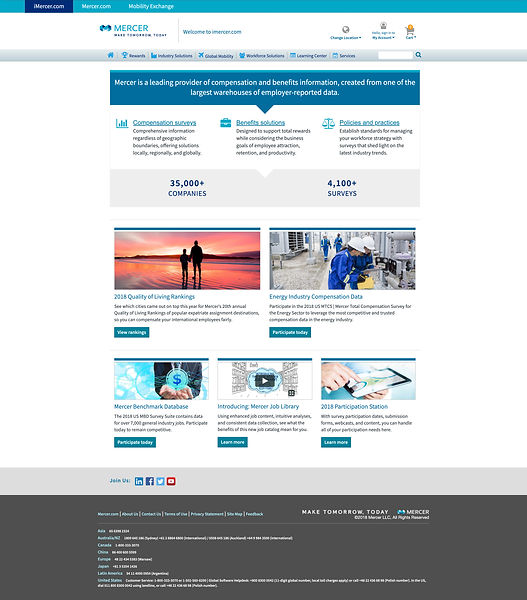

After
Product page redesign
Content and layout were evaluated using a range of analytics tools to identify which information was most viewed, most utilized, and most essential, as well as to determine users’ key pain points that hindered their progression through the purchasing funnel.
Page redesign breakdown at bottom.
Before


Product page redesign breakdown
-
Through UI enhancements, lessened amount of competing CTAs, yet created more obvious secondary-CTAs.
-
"Purchase options", pricing, and "Add to Cart" moved to the top right side of the page. No more digging for pricing and purchasing – the main purchasing needs are right up top. Previously purchasing was at the bottom of the page hidden in a tabbed interface.
-
Tooltips in the purchase box to explain concepts that some users might not understand, such as what being a Participant or Non-participant means, and what the “WIN access” or other access methods means.
-
More interactive components to minimize lengthy content / descriptions, such as the "Product Highlights" accordion section.
-
Put the Product Details and the Product Highlights above the fold (Publish date, Positions published, Organizations, Observations) for users to get the most important content asap:

-
Created a secondary "Product Details" tabbed section to provide more lengthy content and to contain “the proof” of the product details, such as videos, demos, sample reports and downloadables.

-
Through user research we discovered that clients often did not have a clear idea what was going to happen after they purchased a product. Sometimes access required additional time and info. This section:
-
Clearly explained the process as well as providing a direct path to Customer support.
-
Reduced the calls to Customer support, directly reflecting a more effective, user-friendly design that delivered measurable business value through cost reduction and improved customer experience.
-

-
Added a specific section for Survey Participation and to answer participation questions.

-
Added a FAQs section that answers most commonly asked questions from clients. This also reduced customer-support calls which lowered operational costs and freed support teams to focus on more complex issues, improving overall efficiency.

Information Architecture (IA) redesign and template imlementation
imercer.com
-
The website underwent a structural and visual redesign to establish a clear hierarchy of page types - including Level 1 pages, Level 2 pages, product pages, etc. — ensuring a consistent and intuitive experience for clients navigating the site.
-
A templated design system was introduced to streamline content creation and editing, giving content editors clear guidance for building new pages.
-
The information architecture and taxonomy were restructured to align with terminology and categories more familiar to clients, further improving overall usability and findability.
Level 1 - Category page

Level 2 - Category detail page

Level 3 - Specific product page

imercer.com - redesign of the user's "My Account" section
-
The account area was redesigned to eliminate the friction caused by the previous card-driven layout, which forced users to leave the page and reorient themselves with each interaction.
-
The new experience uses a persistent, side-based navigation that allows users to move fluidly between account sections while maintaining context.
-
This design reduces cognitive load by keeping all options visible and predictable, supports faster task completion, and helps users build a clearer mental model of their account structure.
-
Overall, the redesign creates a more intuitive, efficient, and user-centered experience that better supports common account management tasks.

imercer.com - redesign of the whole checkout process
Users were abandoning checkout due to a long, fragmented flow, limited visibility into their purchase details, and friction around delivery information. These issues also created downstream operational challenges, including increased Customer Service calls to collect missing fulfillment details.
-
Research & Insights
We analyzed usability studies, heatmaps, and analytics to identify drop-off points and user confusion within the existing checkout. Research revealed that users wanted fewer steps, clearer confirmation of their order details, and a more seamless mobile experience. Accessibility gaps were also identified that prevented the flow from meeting WCAG requirements.
-
Design Approach
The checkout was restructured to reduce the number of steps required to complete a purchase while maintaining clarity and user confidence. A persistent order summary was introduced to keep the entire purchase visible throughout the process, reinforcing transparency and minimizing errors. Required delivery information was intentionally collected at the right moments in the flow to support successful fulfillment without overwhelming the user.
-
Accessibility & Mobile Optimization
The experience was fully optimized for mobile, with responsive layouts, larger touch targets, and simplified interactions. Accessibility improvements were implemented to meet WCAG standards, including clearer form labels, improved contrast, keyboard navigation support, and screen-reader compatibility.
-
Outcomes
The redesigned checkout created a faster, more intuitive, and accessible purchasing experience. Improved data collection reduced the need for Customer Service follow-up calls, while the streamlined flow and persistent summary supported higher completion rates and a smoother path to purchase.
Cart page: Added collection of the 3 users information (that came with the purchase of the product) so Customer service did not have to spend a lot of time tracking down that info. Reduced calls to our Contact Center and delivered the product quicker to the client.


Checkout page: Reduced # of steps to finish order to 3 steps; all of which can be done with leaving the page. Previous steps could be accessed and edited. Also kept a persistent "Order Summary" to the right.
Since Mercer is a B2B company, many times clients couldn't just check out with a credit card, they needed to submit an invoice to their company to get authorization for purchasing. We added options to choose your "payment type".

Product page: implemented an "Added to cart" popup so it's clear that the product actually got added to the cart, tells them how many other items are in their cart, and gives them options to stay on the page or go to checkout. All without leaving the page they are on. This popup was for desktop only which is how most of our users access our sites. Mobile optimization used a modified version so the popup didn't take over the screen
Additional imercer work
-
Wishlist creation - for client YOY survey product purchases
-
Notification and alert system - to alert of software system downtimes and other important info.
-
Promotional ad system using a templated back-end solution. This allowed being able to quickly add sales banners to only certain specific surveys, products or landing pages. Greatly reduced the hours spent putting sales up on hundreds of specific pages (while excluding other pages).
-
Created a built-in A/B testing system - allowed incremental testing to be done quickly and fast iterations to market.
Shop.mercer.com
Projects and designs coming soon...


